
Zirconia, E-max, porcelain-fused-to-metal, gold — ask about dental crowns and you’ll hit a wall of material names with no clear explanation of what actually separates them. Some clinics push one material regardless of the tooth, when in reality the “best” crown material depends heavily on where in your mouth it’s going and what you use your teeth for.
This guide breaks down all four crown materials offered at GD Smile Studio — how each one performs, what it looks like, and which teeth it’s actually suited for — so you walk into your consultation already knowing what to ask.
How Dental Crowns Work & Why Material Matters
A dental crown is a custom-made cap that fully covers a damaged, weakened, or cosmetically compromised tooth, restoring its shape, strength, and appearance. The material it’s milled or built from determines three things that matter most to you: how much visible light it lets through (affecting how natural it looks), how much bite force it can withstand before fracturing, and how it interacts with your gums over time.
None of the four materials below is universally “best” — each one trades off strength against aesthetics differently, which is exactly why your dentist will often recommend different materials for different teeth in your own mouth. For a broader look at the crown treatment process itself, see our dental crowns in Turkey guide.
Quick note: Your dentist will confirm which materials are viable for you during your consultation, based on the tooth’s location, your bite pattern, and whether you grind your teeth. The comparisons below are a starting point for that conversation, not a substitute for it.
Zirconia (Zirconium) Crowns
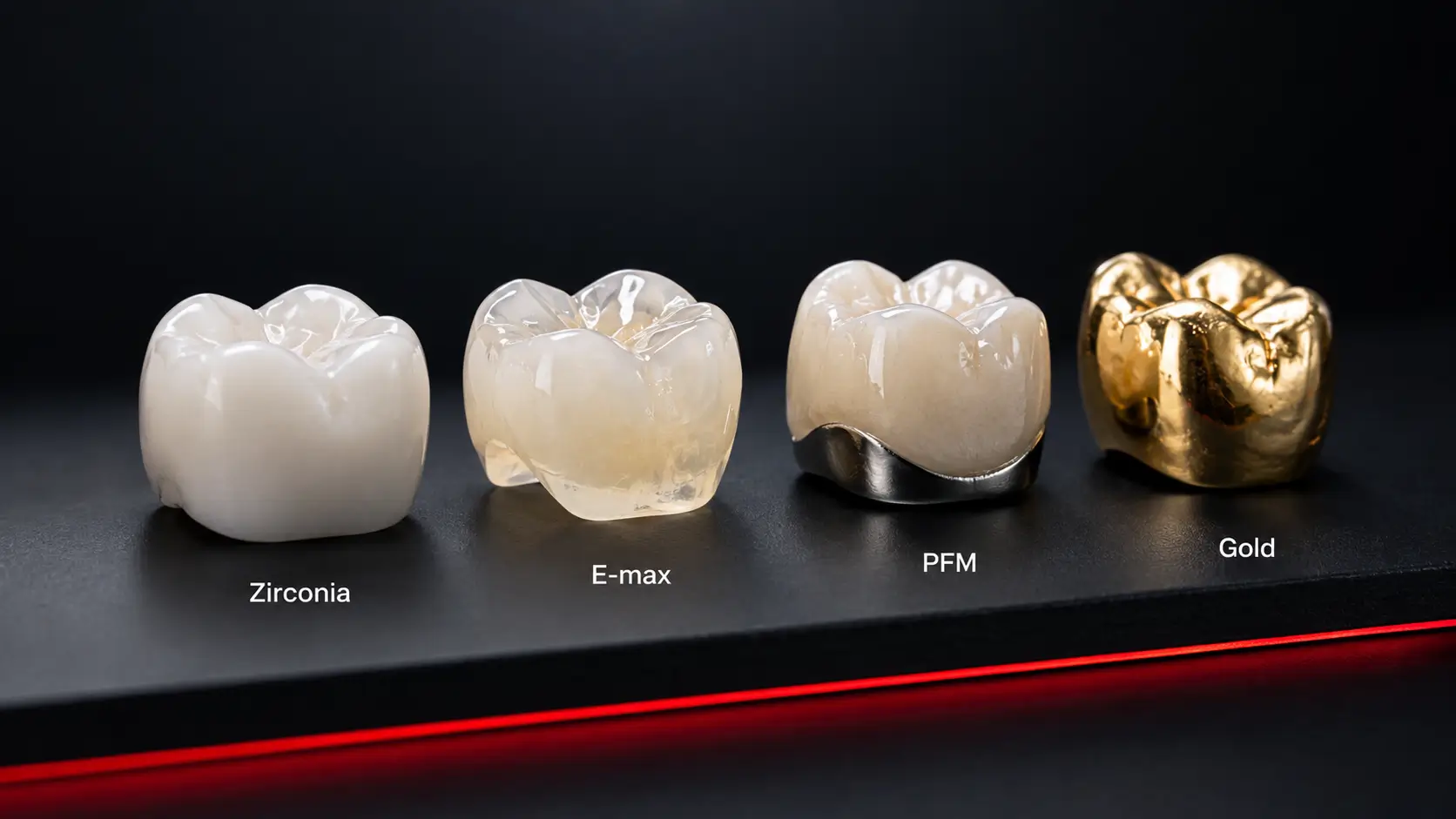
Zirconia — zirconium dioxide — is the strongest ceramic material used in modern crowns, and it’s usually milled as a single solid piece (monolithic), which removes weak points like layered joints. Its main trade-off has historically been aesthetics: earlier zirconia was noticeably more opaque than natural enamel. Modern multi-layer zirconia has closed much of that gap, though it’s still generally considered slightly less translucent than E-max.
Zirconia crowns tend to suit you if:
- You grind your teeth (bruxism) or have a naturally strong bite
- The crown is going on a molar or premolar, where chewing forces are highest
- You want the most fracture-resistant option available, even if it means a very slight trade-off in light translucency
- You’d prefer a metal-free crown for personal or sensitivity reasons
Worth knowing: Zirconia’s strength advantage matters most for back teeth doing heavy chewing work. For a front tooth under normal biting forces, the strength gap over E-max is rarely the deciding factor — appearance usually is.
See full details on zirconia dental crowns at GD Smile Studio.
E-max (Lithium Disilicate) Crowns
E-max is the brand name most patients recognise for lithium disilicate — a glass-ceramic material prized above all for how closely it mimics natural tooth enamel. It transmits light in a way that creates the same soft, layered translucency real teeth have, which is why it’s often the material of choice for crowns that need to blend seamlessly into a visible smile.
The trade-off is strength: E-max is durable and handles normal biting forces well, but it’s more prone to fracturing under heavy or repetitive load than zirconia — particularly relevant if you grind your teeth or have a strong bite on a back tooth.
E-max crowns tend to suit you if:
- The crown is going on a front tooth that shows when you smile
- Matching the natural translucency of surrounding teeth is your top priority
- You don’t have a diagnosed grinding habit or unusually heavy bite on that tooth
- You want a metal-free, highly aesthetic single-tooth or multi-tooth restoration
Worth knowing: For back teeth under heavy chewing load, or in patients with confirmed bruxism, most dentists lean toward zirconia over E-max — not because E-max is a weaker product, but because that specific tooth position puts more stress on it than E-max is best suited to handle long-term.
See full details on E-max dental crowns at GD Smile Studio.
Porcelain-Fused-to-Metal (PFM) Crowns
PFM crowns use a metal inner coping — typically a base metal alloy — covered with a layer of tooth-coloured porcelain. For decades this was the standard crown material before all-ceramic options like zirconia and E-max became strong enough to compete, and it’s still a solid, budget-conscious choice today, particularly for teeth further back in the mouth.
The honest trade-off: because the metal core blocks light, PFM crowns look slightly more opaque than all-ceramic options, and as gums naturally recede with age, a thin grey line can become visible at the gumline where the metal coping shows through. This is a known, well-documented characteristic of the material — not a sign of a failed crown — but it’s worth knowing about upfront.
PFM crowns tend to suit you if:
- The crown is going on a back tooth that isn’t highly visible when you smile
- You want a reliable, well-proven material at a lower cost than all-ceramic options
- You need strong support for a bridge spanning multiple teeth
Worth knowing: If the crown is going on a front tooth or anywhere visible in your smile, most dentists will steer you toward E-max or zirconia instead — PFM’s metal core is best reserved for teeth that do the chewing work out of sight.
See full details on PFM dental crowns at GD Smile Studio.
Gold Crowns
Gold alloy crowns have the longest clinical track record of any crown material in dentistry — it’s common for dentists to see gold crowns placed decades ago still functioning well. Gold wears at a very similar rate to natural tooth enamel, which means it’s exceptionally gentle on the opposing teeth it bites against, unlike harder ceramics that can accelerate wear on teeth they contact.
The obvious trade-off is appearance: gold doesn’t match tooth colour, which is why it’s almost always reserved today for molars that don’t show when you smile, rather than being a first choice for visible teeth.
Gold crowns tend to suit you if:
- The crown is going on a back molar that isn’t visible in your smile
- You have a very heavy bite and want a material that won’t wear down opposing natural teeth
- Long-term durability matters more to you than colour-matching
- You want the most conservative preparation — gold crowns typically require removing less natural tooth structure than ceramic alternatives
Worth knowing: Gold crowns are requested less often today simply because most patients prioritise a natural appearance — but for a back molar under heavy chewing load, it remains one of the most reliable materials in dentistry.
See full details on gold dental crowns at GD Smile Studio.
Comparison Table: Strength, Aesthetics & Best Use
Here’s all four materials side by side. Strength figures below reflect commonly reported flexural strength ranges from dental material research — they’re a general guide, not a specific claim about any individual crown.
| Material | Relative Strength | Aesthetics | Best For |
|---|---|---|---|
| Zirconia | Highest (~1,000–1,200 MPa) | Good, slightly less translucent than E-max | Molars, grinders, strong bite |
| E-max | Moderate–high (~350–450 MPa) | Excellent — closest match to natural enamel | Front teeth, visible smile |
| PFM | High (metal core) | Good, can show grey line at gumline over time | Back teeth, bridges, budget-conscious |
| Gold | Very high, gentlest on opposing teeth | Metallic — not tooth-coloured | Molars not visible in smile |
Worth knowing: Many patients don’t pick just one material — it’s common to have zirconia or PFM on back molars and E-max on visible front teeth, matched to what each tooth actually needs.
Front Teeth vs Back Teeth: Does Position Change the Answer?
Yes — and this is one of the most useful things to understand before your consultation. Front teeth and back teeth do fundamentally different jobs in your mouth, so the “best” material genuinely depends on which one you’re restoring.
Front Teeth (Incisors, Canines)
Take relatively light biting forces but are constantly visible when you speak and smile. E-max is usually the top recommendation here; zirconia is a solid alternative if strength is a priority for you.
Back Teeth (Premolars, Molars)
Absorb the majority of your chewing force and are rarely visible when you smile. Zirconia, PFM, or gold are typically recommended, prioritising strength and longevity over colour-matching.
If you grind your teeth at night (bruxism), this consideration matters even more — your dentist may recommend zirconia across more of your mouth than they otherwise would, including on teeth where E-max would normally be the aesthetic first choice.
How to Know Which Crown Material Is Right for You
You don’t need to land on an answer alone — your dentist will confirm the right material once they’ve seen your teeth. These are the main factors that shape that recommendation:
- Where the tooth is: front teeth prioritise appearance, back teeth prioritise strength.
- Whether you grind your teeth: confirmed bruxism generally shifts the recommendation toward zirconia.
- Bite strength: a naturally heavy bite favours the stronger materials, regardless of tooth position.
- Budget: PFM is typically the most cost-effective option; all-ceramic and gold sit at a higher price point.
- Whether it’s a single crown or a bridge: bridges spanning multiple teeth have different structural requirements than a single crown.
Send a few photos of your teeth and our dentists will review them and recommend the right material for your specific case, free and with no obligation.
Not sure which crown material fits your case? Get a free, no-obligation treatment plan from our specialist team.
Why UK & European Patients Choose GD Smile Studio
Whichever material ends up being right for your teeth, it’s worth knowing who’s placing the crown. GD Smile Studio is part of Gürses Dental Health Group, based in Kağıthane, Istanbul, and is a licensed health-tourism provider under the Turkish Ministry of Health.
Licensed & Accredited
Licensed by the Turkish Ministry of Health and accredited by HealthTürkiye as a health-tourism provider.
4.4/5 on Trustpilot
Independently reviewed patient feedback, publicly verifiable on Trustpilot.
English-Speaking Team
Coordinators available 7 days a week, including evenings and weekends, from first message to aftercare.
Trip Handled for You
Hotel stay and VIP airport transfers included with treatment packages.
Your consultation, treatment plan, 3D imaging and X-rays are all included at no cost and with no obligation — you’ll know exactly which crown material is recommended for each tooth, and why, before deciding anything. Meet the clinical team on our dentists page.
Frequently Asked Questions
What’s the difference between zirconia and E-max crowns?
Both are all-ceramic, metal-free materials. Zirconia is the stronger of the two, making it a common choice for molars and patients with a heavy bite. E-max is more translucent and closely mimics natural enamel, making it the usual first choice for visible front teeth. Neither is “better” overall — the right one depends on which tooth and how much bite force it handles.
Are gold crowns still used today?
Yes, though less often than ceramic options due to their metallic colour. Gold remains one of the most durable crown materials available and is gentle on opposing teeth, which is why it’s still recommended for back molars that don’t show when you smile and need to withstand heavy chewing forces.
Why do porcelain-fused-to-metal crowns sometimes show a grey line?
PFM crowns have a metal coping under the porcelain layer. As gums naturally recede over the years, that metal edge can become visible at the gumline. It’s a well-documented characteristic of the material rather than a sign of a problem, and it’s one reason all-ceramic materials are often preferred for visible front teeth.
Which crown material lasts the longest?
Gold has the longest documented clinical track record, with many gold crowns still functioning decades after placement. Zirconia is the most fracture-resistant of the ceramic options. With proper care, all four materials covered in this guide are designed as long-term restorations.
Can I choose different crown materials for front and back teeth?
Yes, and it’s common practice. Many patients use E-max on visible front teeth for the most natural look, and zirconia, PFM, or gold on back molars where strength matters more than colour-matching.
Is zirconia or E-max better for people who grind their teeth?
Zirconia is generally the safer choice for patients with confirmed bruxism, thanks to its higher fracture resistance under repeated heavy load. E-max can still be used in these cases, but your dentist will assess your specific bite pattern before recommending it for a tooth that experiences significant grinding force.
Ready to Find Out Which Crown Material Fits You?
Send a few photos or X-rays and get a free, no-obligation treatment plan — response within 15 minutes.
4.4/5 Excellent on Trustpilot · Licensed by Ministry of Health · English-speaking coordinators, 7 days a week