
Porcelain, laminate, Empress — veneer material names get thrown around interchangeably online, but they’re genuinely different treatments with different amounts of tooth preparation, different price points, and different results. Choosing based on price alone, without understanding what you’re trading off, is how patients end up disappointed with an otherwise well-executed treatment.
This guide breaks down all three veneer materials offered at GD Smile Studio — how much of your natural tooth each one requires, what they look like, and which patients each one genuinely suits — so you arrive at your consultation already asking the right questions.
How Veneers Work & Why Material Matters
A veneer is a thin custom shell bonded to the front surface of a tooth to change its shape, colour, or alignment — unlike a crown, which covers the entire tooth. The material and thickness of that shell determine two things that matter most: how much of your natural tooth enamel needs to be removed to fit it, and whether the result is reversible if you ever change your mind.
These are two genuinely different treatments wearing similar names, not one product in three finishes — which is exactly why understanding the difference matters before you commit. For a broader look at the veneer treatment process itself, see our dental veneers in Turkey guide.
Quick note: Your dentist will confirm which materials are realistic for your teeth during your consultation — tooth size, spacing, and existing discolouration all affect which options are actually on the table for you.
Porcelain Veneers
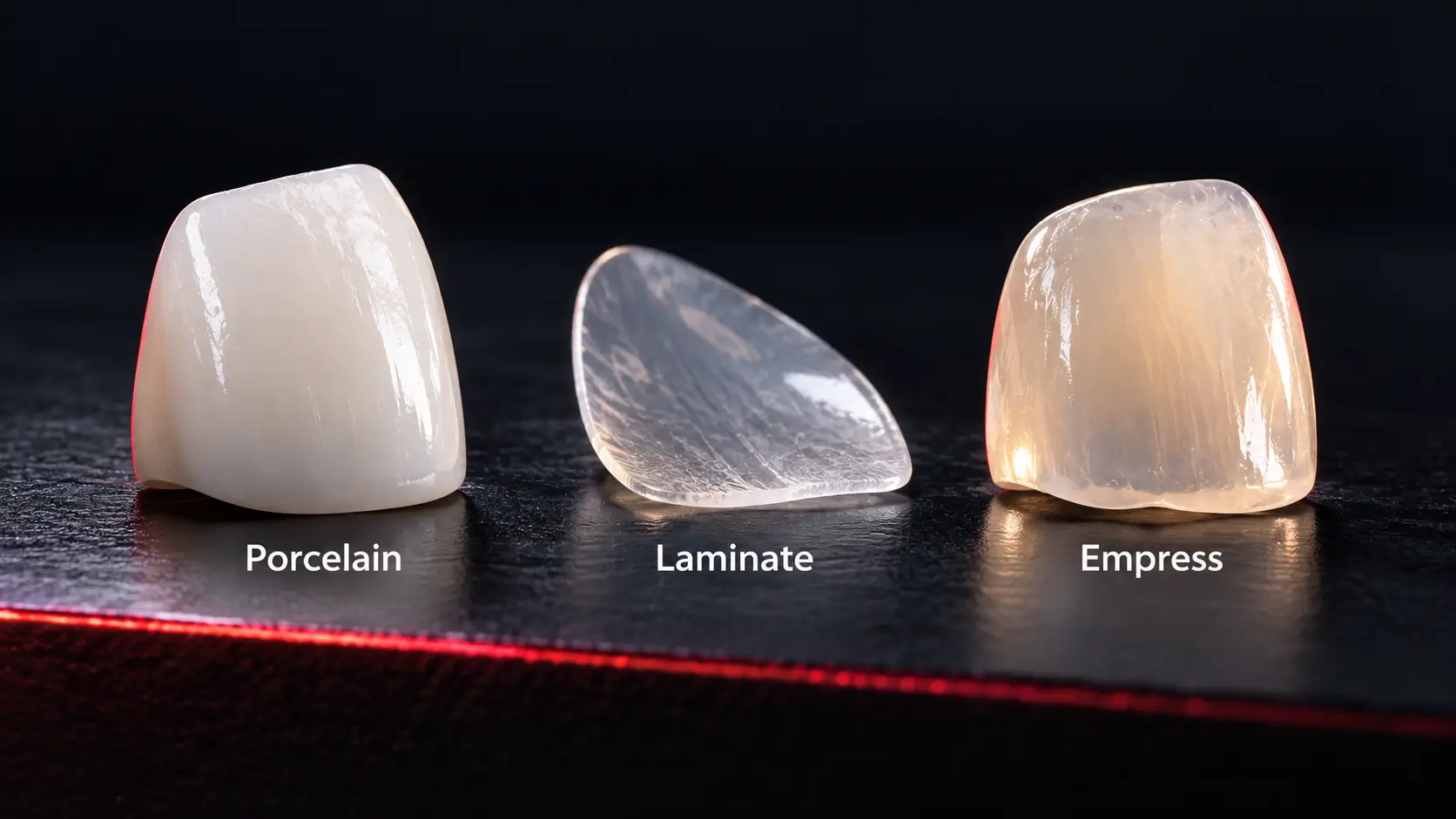
Porcelain veneers are the traditional, most established veneer option. Your dentist removes a thin layer of enamel — typically around 0.5 to 0.7mm — from the front of each tooth, creating precise space for a custom ceramic shell that’s bonded on top. That small amount of enamel removal is what allows porcelain veneers to sit flush against the tooth without looking bulky, while giving the lab room to build in natural-looking depth and translucency.
Because enamel is removed, this treatment is considered permanent: once prepared, the tooth will always need to be covered by a veneer or crown going forward. In exchange, porcelain veneers are highly durable, stain-resistant, and can correct more significant issues than thinner alternatives.
Porcelain veneers tend to suit you if:
- You’re correcting noticeable discolouration, chips, or misalignment that thinner veneers can’t fully mask
- You want the most durable, long-established veneer option with a proven track record
- You’re comfortable with a permanent treatment in exchange for the most versatile results
- You’re planning a full smile makeover across multiple teeth
Worth knowing: “Permanent” here means irreversible, not high-maintenance — porcelain veneers need nothing beyond your normal oral hygiene routine. It simply means the decision to prepare the tooth can’t be undone later.
See full details on porcelain veneers at GD Smile Studio.
Laminate (No-Prep / Ultra-Thin) Veneers
Laminate veneers — also called no-prep or ultra-thin veneers — are built to roughly 0.2 to 0.3mm, often compared to the thickness of a contact lens. Because they’re so thin, they can be bonded directly onto the front of the tooth with little to no enamel removal, sometimes with only light surface conditioning to help the bond hold.
The main appeal is that the procedure is far less invasive: in many cases your natural tooth structure stays fully intact, and if you ever wanted them removed, your teeth would return close to their original state. The trade-off is versatility — because there’s so little material to work with, laminate veneers work best for smaller cosmetic corrections rather than significant discolouration or misalignment.
Laminate veneers tend to suit you if:
- Your natural teeth are already reasonably well-aligned and lightly discoloured, not significantly damaged
- You want to close small gaps or subtly reshape teeth without permanently altering them
- Preserving your natural enamel matters to you as much as the cosmetic result
- You’d prefer a treatment that’s generally reversible if your preferences change later
Worth knowing: “No-prep” describes the goal, not a guarantee — if your teeth are very small, short, or unevenly shaped, your dentist may still recommend minor shaping to get proportions right, regardless of which veneer type you choose. This is confirmed during your consultation, not assumed beforehand.
See full details on laminate veneers at GD Smile Studio.
Empress Veneers (Pressed Ceramic)
Empress veneers use a pressed glass-ceramic system, best known for producing some of the most naturally translucent, tooth-like results available in cosmetic dentistry. Rather than being milled or layered, the ceramic is heat-pressed into shape, a process that’s been refined and clinically studied for over two decades — Empress has one of the longest independently published track records of any all-ceramic veneer system on the market.
In terms of tooth preparation, Empress typically sits between porcelain and laminate veneers: it can often be placed with less enamel removal than traditional porcelain, though exact prep depends on your existing tooth shape and shade. Where Empress genuinely stands out is single-tooth or partial-arch cases where matching the surrounding natural teeth is the top priority.
Empress veneers tend to suit you if:
- You’re treating one tooth or a small group of teeth and need it to blend seamlessly with the rest of your smile
- Natural-looking translucency is your top priority over maximum strength
- You want a material with a long, independently documented clinical history
- You’re not planning a full-arch smile makeover, where a stronger material is usually favoured instead
Worth knowing: For full-mouth smile makeovers spanning many teeth, dentists more often reach for stronger materials like E-max — Empress’s strength lies in single-tooth and partial-case aesthetics, not full-arch durability.
See full details on Empress veneers at GD Smile Studio.
Comparison Table: Thickness, Prep Required & Best Use
Here’s all three materials side by side, based on the factors that actually matter when choosing between them.
| Material | Typical Thickness | Tooth Preparation | Best For |
|---|---|---|---|
| Porcelain | ~0.5–0.7mm | Enamel removed, permanent | Significant discolouration, chips, full smile makeovers |
| Laminate (No-Prep) | ~0.2–0.3mm | Minimal to none, generally reversible | Small gaps, mild discolouration, preserving natural enamel |
| Empress | Between porcelain and laminate | Often less than porcelain, case-dependent | Single-tooth or partial cases prioritising natural translucency |
Worth knowing: Thickness and prep requirements vary somewhat by lab and case complexity — the ranges above are typical, not fixed. Your dentist confirms exact figures for your teeth during your consultation.
How Much Tooth Preparation Really Matters
This is usually the single biggest factor patients underweight when comparing veneer options — and it’s worth being direct about. Once enamel is removed for porcelain veneers, it doesn’t grow back. That tooth will need a veneer or crown covering it for the rest of its life. This isn’t a downside so much as a fact worth deciding on deliberately, not discovering afterward.
Laminate veneers exist specifically to avoid that trade-off — but the honest caveat is that “no-prep” describes an aim, not a guarantee for every tooth. If your natural teeth are already well-aligned and only need subtle cosmetic correction, minimal prep is realistic. If they’re more uneven or your dentist needs room to correct significant misalignment, some enamel shaping is often still necessary regardless of which veneer type you choose.
Empress sits in between: it frequently requires less reduction than traditional porcelain, but exactly how much depends on your specific case, not the material name alone.
Worth knowing: Ask your dentist directly during your consultation how much tooth structure will be removed for your specific case, not just which material you’re getting. The material name tells you the general range — your consultation tells you the actual number.
How to Know Which Veneer Material Is Right for You
Your dentist will confirm the right material once they’ve assessed your teeth, but these are the main factors that shape that recommendation:
- How many teeth you’re treating: single-tooth or partial cases have more material options than a full-arch makeover.
- How much correction you need: significant discolouration or misalignment generally points toward porcelain; subtle changes suit laminate.
- How you feel about permanence: if keeping your options open matters to you, that shifts the conversation toward laminate.
- Your priority — strength or translucency: full-mouth makeovers often lean on stronger materials; single visible teeth can prioritise Empress’s natural light transmission.
- Budget: laminate and porcelain are typically closer in cost to each other than either is to a full-arch Empress case.
Many patients also combine veneers with a full Hollywood Smile makeover for a complete, coordinated result across the whole smile rather than treating teeth individually. Send a few photos of your teeth and our dentists will recommend the right material and approach for your specific case, free and with no obligation.
Not sure which veneer material fits your case? Get a free, no-obligation treatment plan from our specialist team.
Why UK & European Patients Choose GD Smile Studio
Whichever material ends up being right for your smile, it’s worth knowing who’s placing it. GD Smile Studio is part of Gürses Dental Health Group, based in Kağıthane, Istanbul, and is a licensed health-tourism provider under the Turkish Ministry of Health.
Licensed & Accredited
Licensed by the Turkish Ministry of Health and accredited by HealthTürkiye as a health-tourism provider.
4.4/5 on Trustpilot
Independently reviewed patient feedback, publicly verifiable on Trustpilot.
English-Speaking Team
Coordinators available 7 days a week, including evenings and weekends, from first message to aftercare.
Trip Handled for You
Hotel stay and VIP airport transfers included with treatment packages.
Your consultation, treatment plan, and smile design preview are all included at no cost and with no obligation — you’ll know exactly which veneer material is recommended for your teeth, and why, before deciding anything. Meet the clinical team on our dentists page.
Frequently Asked Questions
What’s the difference between porcelain and laminate veneers?
Porcelain veneers require removing about 0.5–0.7mm of enamel and are considered a permanent treatment. Laminate veneers are ultra-thin (0.2–0.3mm) and are bonded with minimal to no enamel removal, making them generally reversible. Porcelain suits more significant corrections; laminate suits subtle cosmetic changes.
Are laminate veneers really reversible?
In most cases, yes — because little to no enamel is removed, your natural tooth structure stays largely intact underneath. However, “no-prep” is an aim rather than a guarantee for every tooth; some cases still need minor shaping, which your dentist will explain during your consultation.
What makes Empress veneers different from porcelain veneers?
Empress uses a pressed glass-ceramic system known for exceptional natural translucency, with one of the longest independently published clinical track records of any all-ceramic veneer material. It typically requires less tooth reduction than traditional porcelain and is often chosen for single-tooth or partial-case work where matching surrounding teeth is the priority.
How much tooth is removed for veneers?
It depends on the material: porcelain typically requires 0.5–0.7mm of enamel removal, laminate veneers require minimal to none, and Empress usually falls somewhere in between. Your dentist confirms the exact amount for your specific teeth during your consultation.
Which veneer type lasts the longest?
Porcelain veneers are generally considered the most durable option for withstanding daily wear, while Empress has one of the longest documented clinical histories of any all-ceramic veneer system. With proper care, all three materials covered in this guide are designed as long-term cosmetic solutions.
Can I combine veneers with a Hollywood Smile makeover?
Yes — many patients choose veneers as part of a broader Hollywood Smile treatment plan, coordinating shade, shape, and alignment across the whole smile rather than treating individual teeth separately.
Ready to Find Out Which Veneer Material Fits You?
Send a few photos or X-rays and get a free, no-obligation treatment plan — response within 15 minutes.
4.4/5 Excellent on Trustpilot · Licensed by Ministry of Health · English-speaking coordinators, 7 days a week